Best Knife Steel For Bushcraft, EDC And Outdoor Use
Posted by Heinnie Haynes on 23rd Oct 2026
Ask five knife-literate people what the best knife steel is and you'll likely get five different answers. They're not disagreeing with each other so much as answering five different questions without realising it.
Our knives and tools range covers everything from wet-weather bushcraft blades to pocket-friendly EDC folders, because no single steel does every job well. This guide to knife steel and blade selection breaks the choice down into the four properties that actually decide it, then matches real steels to real use, so you can pick the one that suits your job rather than the one that tops somebody else's list.
Estimated reading time: 8 minutes
What is the best steel for knives?
There isn't one. A steel that suits a farmer's folder at first light would be the wrong choice for a hunter working in the rain, and a carbon steel a bushcrafter swears by would rust through in a damp boat cabin within a season. What defines the best knife steel is a match between four measurable properties and the job in front of you, not a fixed ranking you can look up once and forget.
MagnaCut has become the reference point most enthusiasts measure other steels against, because it balances edge retention, toughness and corrosion resistance more evenly than most stainless steels manage. That doesn't make it automatically the best knife steel for your situation, and the rest of this piece explains why.

Why is knife steel important?
Steel is the one part of a knife you can't fix with good design. A beautifully ground blade in the wrong steel still won't hold an edge through a morning's work, and it won't corrode-proof itself against sea air either. Get the handle wrong and you notice straight away. Get the steel wrong and you notice three months in, when the edge needs stropping after every single task.
Knife steel matters more than almost any other spec on the page because it sets the ceiling on everything the knife can do, and no amount of clever grinding raises it.
The four properties of blade steel
Every steel choice comes down to trading off four things against each other, and understanding them helps explain most of what follows.
Edge retention. How long the blade stays sharp before it needs touching up, driven mainly by carbide content and hardness.
Toughness. How well the edge and spine resist chipping or snapping under load, particularly during batoning or prying.
Corrosion resistance. How well the steel shrugs off damp, salt air and blood without staining or pitting. Chromium content does most of the work here.
Sharpenability. How easily you can restore the edge with ordinary stones, rather than needing diamond plates.
Once you know what each one does, a fairly obvious question follows.
Why can't one steel do all four well?
No steel maximises all four at once. Push edge retention up with more carbide, and you generally lose some toughness and sharpenability. Push toughness up and you usually give up some edge retention. This is the trade-off metallurgist Larrin Thomas writes about at length on Knife Steel Nerds, the blog most serious knifemakers treat as the reference point on steel behaviour. Every property gained comes at the expense of another. Every steel on this page sits somewhere different on that trade-off, and the right one for you is the one whose compromise matches yours.
Important knife steel terms
A few terms come up constantly so here's what they mean and why they matter before you read further.
HRC. The Rockwell hardness scale. Higher numbers generally mean better edge retention and worse toughness.
Scandi grind. A single flat bevel that sharpens easily in the field, which is why it turns up on so many bushcraft blades.
Powder metallurgy (CPM or PM prefix). Steel made by compacting fine metal powder rather than casting it. The carbide structure comes out more even, which usually means better all-round performance than a cast steel of similar composition.
Those three types cover most of what you'll meet browsing product pages, and knowing their benefits explains a lot of what you'll read below. Everything else is really just a variation on the four properties above.
Choosing the best steel for knives and survival tools
What actually goes wrong for you if the steel gets it wrong? A blunt edge halfway through a job is one problem. A rusted blade left in a wet sheath overnight is another, and a chipped tip after prying open a crate is a different problem again. None of them get fixed by the same steel, so knowing which one you're actually worried about matters more than any spec sheet.
Here's how the factors to consider when choosing steel stack up against three common situations.
| Situation | The failure that actually happens | The property that fixes it |
|---|---|---|
| Wet, coastal or damp storage | Pitting and staining on an unprotected blade | Corrosion resistance |
| Heavy chopping, batoning, prying | A chipped edge or a snapped tip | Toughness |
| Long sessions without a strop | An edge that rolls or dulls mid-task | Edge retention |
Sharpenability doesn't fix a specific failure on its own. Instead, it decides how much of a chore recovering from any of those failures turns out to be, and that's why it still matters even when it isn't the headline reason you chose a steel.
Our range spans both ends of that trade-off. Budget-friendly stainless steels sharpen in minutes on a basic stone, and premium powder-metallurgy steels hold an edge for weeks of hard use. Which end suits you depends entirely on the failure mode you just worked out above.


What is the best steel for a bushcraft knife?
Bushcraft work asks for a steel that sharpens easily in the field and shrugs off the toughness demands of batoning and carving. That usually means a simple carbon steel or a tough stainless like MagnaCut. Bushcraft puts a knife through repeated field sharpening and constant wood contact and, more often than most buyers expect, it also means direct exposure to rain, mud and river water.
The Becker Companion MagnaCut shows why that choice matters in practice. Its 13.3cm blade is full tang, ground flat and built for wood processing and food prep in wet conditions. It's made in MagnaCut because bushcraft asks a lot of a steel at once. An edge needs to keep working through a full day's batoning and carving. A spine needs to survive the first hard strike without chipping. A surface needs to shrug off a week of rain without a stainless compromise costing you edge retention along the way. A simple high-carbon steel would bring its own trade-off, because you’d be oiling the blade every evening to stop it marking.
The favourite bushcraft knife blade steel argument usually comes down to maintenance. Carbon steel fans accept the oiling routine as part of owning the blade. Stainless converts would rather spend that time carving, and they like a steel that shrugs off a week of rain. Sharpening follows hardness, whatever the steel type. A harder edge lasts longer between sessions but takes more effort to restore, and a softer one comes back quickly but needs the attention more often. Neither side is wrong. They’re simply weighting the same four properties differently, and both conclusions are entirely defensible, depending on how wet your bushcraft actually gets.
What knife steel is best for outdoor use?
Outdoor use covers more ground than bushcraft alone. The steel that suits a coastal fisherman differs from the one that suits someone splitting logs at a static camp, and general outdoor use pulls away from bushcraft mainly on exposure. Paddling, wading and overnight storage in a damp tent all push corrosion resistance higher up the list than it sits for a knife that mostly lives in a dry pack.
Sandvik's stainless range, 12C27 and 14C28N, earns its reputation here. It stays easy to keep razor sharp with basic kit, and it resists the corrosion that ruins a knife left in a wet sheath overnight. It won't out-chop a premium tool steel on raw toughness. But, for an outdoor buyer whose knife spends more time near water than splitting rounds, that trade rarely matters. If your outdoor use runs harder, toward felling and heavy batoning, the same MagnaCut logic from the bushcraft section above still applies. You're buying toughness and corrosion resistance together and accepting a slightly tougher sharpening session in exchange.
What is the best steel for EDC knives?
EDC changes the calculation. The failure mode isn't a chipped edge in the field anymore. It's a knife that's too heavy to carry every day, or too high-maintenance to bother with. The best knife steel for EDC prioritises corrosion resistance and a working edge that survives daily light cutting, ahead of the outright toughness a bushcraft blade needs.
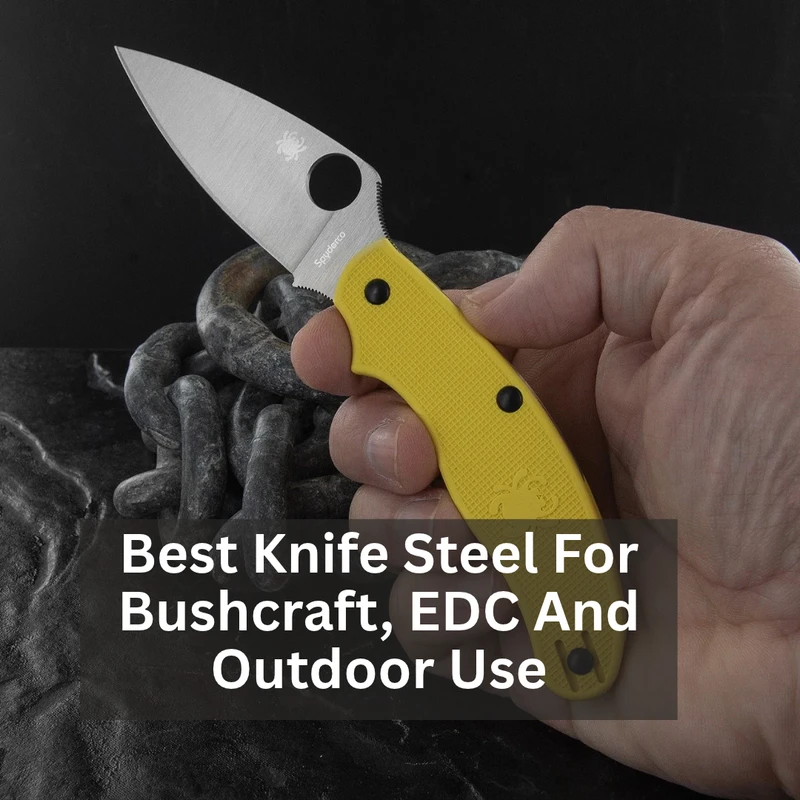
The Spyderco UK Penknife Salt uses the same MagnaCut steel as the Becker Companion above, in a completely different role. At 50 grams, with a slip joint mechanism that keeps it UK-legal to carry without a locking blade, it's built to live in a pocket rather than baton through a log. MagnaCut's balance holds up whether you're asking it for chopping toughness or pocket-friendly corrosion resistance.
A folder you're touching up every day of the week wants a steel that responds well to a strop, not one that demands diamond stones for a five-minute maintenance pass. That's the best knife steel for sharpness in an EDC context, and MagnaCut manages it without much fuss. It's a large part of why the steel has turned up in two very different knives across this guide already.

What is the best steel for hunting knives?
Hunting asks something specific of a steel. It needs to hold a working edge through field-dressing an animal, which is repeated, unglamorous cutting through hide and connective tissue that dulls a blade faster than most buyers expect. It also needs to resist the corrosion that blood and moisture invite.
The Morakniv Hunting Amberg is built around exactly that brief. Its 14C28N blade is cryogenically treated to 58 HRC, and it swaps Mora's usual Scandi grind for a full flat grind with a secondary bevel, specifically to reduce resistance when skinning and processing game. The grind choice matters as much as the steel choice. A full flat edge slides through hide with less drag than a Scandi grind, and 14C28N's corrosion resistance means you're not racing to clean and oil the blade the moment the job's done.
The best steel for hunting isn't automatically the toughest or the longest-holding edge. It's the steel that keeps working through a task that's messier and more corrosive than most outdoor cutting, without demanding constant maintenance mid-job.
What defines the best knife steel
Pull the four sections above together, and a pattern holds. Every use case relies on the same four properties, weighted differently. Bushcraft weights toughness and field sharpenability. General outdoor use, especially anywhere near water, weights corrosion resistance harder. EDC weights corrosion resistance and low-maintenance edge retention over raw toughness, and hunting weights corrosion resistance alongside a working edge through repetitive, corrosive cutting.
None of that makes one steel objectively better than another. It makes "what's the best knife steel?" answerable only once you've answered "what am I actually going to do with it?", which is the order this guide has worked through from the start. If you're still weighing up which knife suits the job in front of you, keep those four properties in mind rather than a name on a spec sheet. Find your use case and the right steel gets a lot easier to spot.
Why not check out our other great blogs For Gear Recommendations And Outdoor Survival Tips