The Practical Carry Checklist: What to Carry for Real Life
Posted by HH on 18th Jun 2026
If you want a practical EDC guide that skips the gear photography and gets straight to what belongs in your pockets, you're in the right place.
Browse our full everyday carry range and use this checklist to build a carry that works in real life: the commute, the job site, the weekend walk. This page is for UK adults who want function without fuss. The format is different from most EDC lists. Instead of cataloguing products by type, it's organised by where and how you carry things, because that's what actually determines whether you use them.
What is EDC gear?
EDC stands for everyday carry. It's the set of tools and items you keep on or about your person on a typical day.
Everyday carry essentials are personal, built through habit. Over time, most sensible carries converge on a common core: something to cut with, something to see by, something to write with and a way to pay. The specifics vary. The principle stays the same.
Real world EDC gear looks less dramatic than the internet might suggest. It's compact, purposeful and largely invisible in daily use. You tend to notice it most when it's missing.
What items do you actually use?
Ask yourself one question before building anything. What do you actually reach for?
Audit a typical week and most people find their useful EDC items cluster into a handful of functions. Cutting, lighting, writing, fixing and carrying essentials.
The most honest EDC examples come from people who've stripped their carry back through trial. The tradesperson who reaches for a knife four times before lunch. The commuter who keeps a pen in their coat because their phone is never to hand when they need to sign something. The walker who started keeping a torch clipped to their keys after one too many muddy car parks at dusk. The parent who's discovered that a small multi-tool takes up less pocket space than the frustration of not having one.
These are your top practical everyday carry items you need. The tools you're grateful for in ordinary moments, that you miss sharply when you've left them behind.

Your practical EDC checklist
Most EDC checklist content is organised by product category: knives, torches, multi-tools. That works as a shopping list. As a framework for building a carry, it's less useful.
This checklist is organised by carry layer. Start with what lives in your pockets. Add what clips to your keys. Then, only if you carry a bag every day, consider what goes in it. The most practical EDC is the one you actually have with you; consistency beats comprehensive every time.
What should go in your pockets every day?
These are your practical EDC items: the tools that leave the house with you every day, without effort or deliberate choice. The everyday carry items list for pocket carry starts here.
Before settling on any item, ask when you last wished you'd had it. Items you've recently reached for in frustration earn a slot; theoretical additions rarely justify the weight.
- A pocket knife: UK knife law permits a folding blade that doesn't lock (under 7.62cm) without requiring a specific reason. A Victorinox Swiss Army knife builds on this with scissors, a screwdriver, a nail file and a cap lifter, all without meaningful extra bulk.
- A compact torch: even in daylight hours, you'll find uses. Under a car bonnet, inside a bag, checking a meter cupboard. A Nitecore keychain model or small pocket torch sits in a pocket without you noticing it.
- A pen: waterproof ink and solid construction matter more than most people expect. The Fisher Space Pen writes at any angle in any weather. Machined brass alternatives from brands like BigIDesign bring the same durability to the pocket.
- Your wallet or card holder: slim, durable and stripped back to what you actually use daily. A card holder from Dango or Trayvax removes the decision entirely.
- Your phone: already with you. Make sure its battery is an asset in your carry, not a liability.
Taken together, these five cover most practical problems on a typical day. Add to them only when you've identified a specific gap.
What tools belong on a keyring or belt clip?
These tools attach to your keys or clip to a pocket edge, which means you have them on you even when the bag stays at home. This is the layer most people overlook.
Four worth considering at this level:
- A keychain torch: smaller than your pocket torch and always present because it's attached to your keys; no separate decision required.
- A carabiner or key organiser: keeps keys quiet, sorted and quick to access, without the bulk of a traditional key fob.
- A compact pocket tool: a Leatherman Micra or Victorinox Classic SD gives you spring-action scissors, a file, screwdrivers and more in something keychain-ready and smaller than a lighter.
- A short whistle or firesteel: negligible weight, and it covers a gap that nothing else in a typical pocket carry addresses.
The principle at this layer is low profile. If it adds friction, you'll leave it behind.
What goes in an EDC bag?
Bag carry is optional. If a bag is part of your daily routine, these are your EDC backpack essentials. The tools that don't belong in a pocket but earn a permanent slot in the main compartment.
Think of bag carry as the layer that handles bigger problems. Pocket carry opens a parcel; bag carry handles a power cut or a field emergency.
- A full size multi-tool: a Leatherman Wave+ or Leatherman Charge+ gives you pliers, wire cutters, a saw, multiple drivers and a blade in one closed unit. Pocket tools simply can't match it for real work.
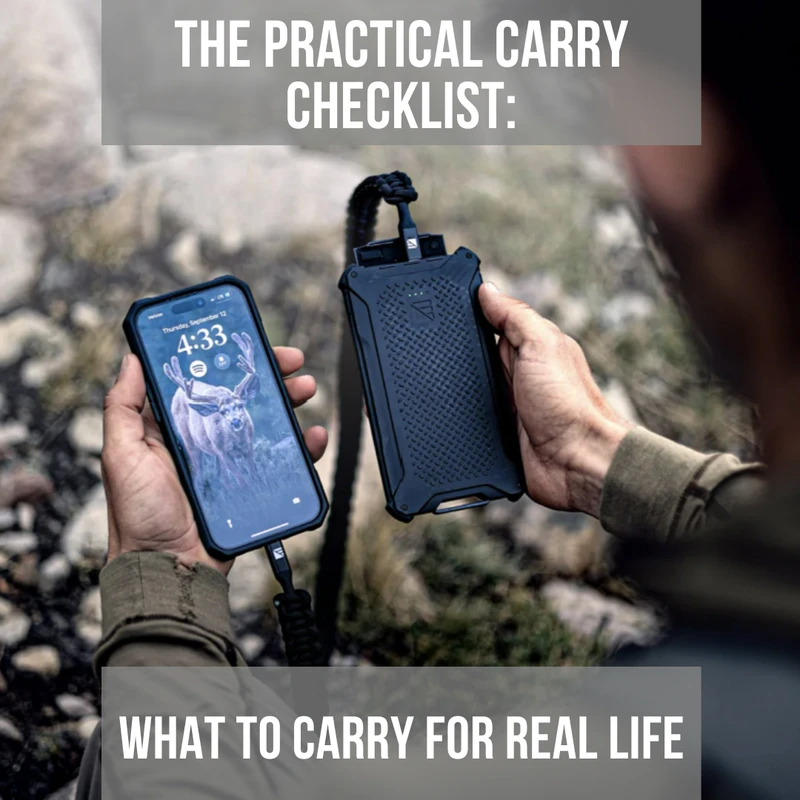
- A power bank: the phone that runs your navigation, payments and calendar shouldn't have no charge before lunch.
- A waterproof notebook: Rite in the Rain or similar. Notes stay legible in any weather, and paper doesn't need charging.
- A compact first aid kit: plasters, wound closure strips and a foil blanket. Enough for common problems, without turning your bag into a field hospital.
- A water bottle or hydration filter: if the bag goes outdoors, your hydration plan should too.
Once this layer is dialled in, most everyday contingencies are covered.
How do I build an EDC kit that's practical, personal and useful?
Building a carry is a process, not a purchase. You carry something, notice what you reach for, remove what you don't and arrive at a kit that's truly yours. That refinement takes time but the principle is straightforward.
Here's a practical guide to everyday carry that doesn't begin with a shopping cart.
Start with your context. A site manager and a graphic designer have different carries. A commuter's urban EDC list looks nothing like a hillwalker's kit. Map a typical week and identify the gaps: the moments where you wished you had something you didn't.
Layer up gradually. Start with the five-item minimalist EDC list: knife, torch, pen, wallet, phone. Add keyring tools only when they solve a real problem. Add bag carry only if a bag is part of your daily routine.
Audit regularly. Every few months, ask which items you haven't touched. Anything unused for three months is almost certainly dead weight.

What's the best practical EDC setup for UK urban life?
The best practical EDC for most UK adults on a working day: a UK legal pocket knife, a compact torch, a reliable pen, a slim wallet and a phone with charge. Everything else is optional until the day it isn't.
An urban EDC list should prioritise low profile, light weight and social context. A folder and a keychain torch are invisible in a city. A full size multi-tool belongs in the bag.
Which EDC setup suits your lifestyle?
EDC ideas work best when they're grounded in a specific use case. The table below covers four real-world starting points.
| Lifestyle | Pocket carry | Bag additions |
|---|---|---|
| Tradesperson | Locking folder (carrying for work purposes can constitute a good reason under UK law), compact torch, pen | Full size multi-tool, gloves, power bank |
| Commuter | Folder (blade that doesn't lock, under 7.62cm), slim wallet, pen | Keychain torch, power bank, waterproof notebook |
| Hillwalker | Folder (blade that doesn't lock), headtorch, whistle (six blasts: the UK mountain distress signal) | Map or GPS, compact first aid kit, hydration |
| Everyday parent | Folder (blade that doesn't lock), compact torch, pen | Small multi-tool, plasters, power bank |
These are starting points, not prescriptions. A carry that works is one that reflects your daily reality, refined gradually over time.
Building a practical EDC collection you'll actually use
A practical EDC collection is built from tools that earn their slot through use. That's what separates a working carry from a drawer full of things bought with good intentions.
A practical guide to real world EDC setup and gear comes down to one question. Does this solve a problem I actually encounter? If you can't recall a recent moment when you'd have reached for it, it probably doesn't belong in the rotation yet.
How to build an EDC kit you'll actually use every day is less a gear question and more a habit question. Start small. Add deliberately. Remove ruthlessly.
The best practical EDC is arrived at through use, not borrowed from a forum thread. And a good practical guide to real world EDC is the same for everyone in principle, however different it looks in practice. Carry what you reach for, strip what you don't, review it periodically.
Browse our full everyday carry range to find everything covered here, from Leatherman and Victorinox to Nitecore and Spyderco, curated by people who carry daily.
If you're not sure where to start, Heinnie Kit Assist puts you in front of one of our team for a free 20-minute call: no script, no pressure, just honest gear advice from people who use the gear.
Why not check out our other great blogs For Gear Recommendations And Outdoor Survival Tips