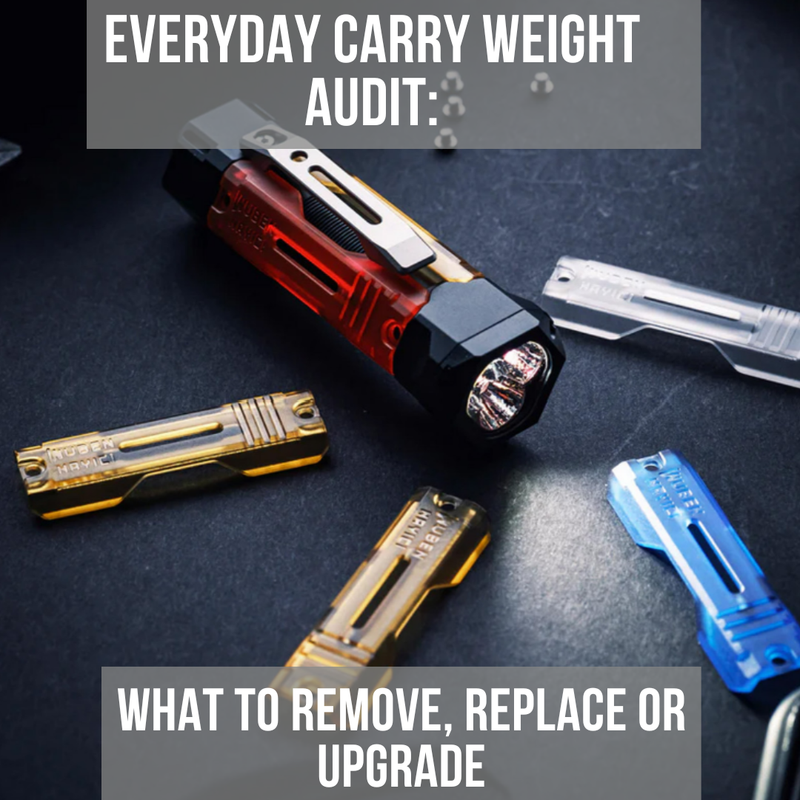
Everyday Carry Weight Audit: What To Remove, Replace Or Upgrade
Posted by HH on 18th Jun 2026
Most people carrying a bag every day have never weighed it. That's worth fixing. Whether you commute into a city, work shifts in the field or simply move through your day with your everyday carry weight spread across pockets, belt and pack, the cumulative load matters more than you probably think.
This guide walks you through a practical everyday carry weight audit. Measure what you're actually carrying, set real targets and reach a clear verdict on every item in your kit. It's most useful when your shoulders are already paying the price by early afternoon, or when your everyday carry kit has drifted from deliberate to accumulated over months of additions and no removals. Work through it once and you'll know exactly what to Remove, Replace, Upgrade or Keep.
How heavy is your EDC?
Most people can't tell you what their bag weighs. They know it's "a bit heavy" or "fine, actually." Without a number, there's nothing to act on. Before you can run an EDC carry weight audit, you need facts, not impressions. The process takes ten minutes and a set of kitchen scales.
Empty your kit completely
Clear your bag, pockets, keyring and belt rig. Lay everything out on a flat surface. Don't start editing yet. The audit depends on an honest snapshot of your current EDC loadout, not a pre-selected version of it. What you think you carry and what you actually carry are often two quite different things.
? The question to answer before you touch the scales
Which item of your EDC gear is the heaviest and why do you carry it? Be honest. Most people know the answer immediately. What varies is whether they can justify it under scrutiny. Start there, before anything else.
Weigh every everyday carry item individually
Work through the pile methodically. Record what your EDC gear weighs against each item: your folding knife, torch, multitool, loaded wallet, keys, phone, notebook, pen, first aid kit, carabiner, power bank and everything else in the pile. If you want to know how much your EDC weighs altogether, this is the only approach that also shows you precisely where the weight is coming from. A total on its own tells you nothing useful. The breakdown tells you everything.
Weigh the empty bag
Set the contents aside when counting everyday carry items and weigh the bag on its own. An empty bag carries its own weight every single day, regardless of what's inside it. A bag weighing 1.8kg before you've added anything already represents a significant portion of most people's total carry, and heavily built bags make that easy to overlook.
Calculate your total EDC carry weight
Add bag weight and contents weight together. That's your full EDC carry weight and it's your starting number for everything that follows. What is the heaviest item in your everyday carry gear? Write it down. It's usually the bag itself, a laptop, a hydration system or a larger tool. That item is your first audit target, and knowing it tells you where the biggest savings are available.
What is the backpack base weight in daily carry?
There's a concept worth borrowing from long-distance hiking: base weight. In ultralight hiking, base weight describes the total weight of your kit minus consumables, so no water, no food and no fuel. Applied to daily carry, it does something useful. It separates the weight you can actually control from the weight that varies day to day regardless.
How to calculate your commuter backpack base weight
Take your total EDC weight and subtract consumable or variable items (water, food and any medication you only carry on specific days). What remains is your commuter backpack base weight. This figure represents the everyday carry weight you'll haul every single day until you make a deliberate change. Total weight shifts daily. Your base weight shifts only when you swap something out, which makes it the number worth focusing on.
Why your EDC gear weight needs a baseline
Without a baseline, weight creep is invisible. For most commuters, base weight makes up the majority of daily carry. The consumables stacked on top are largely unavoidable. The base weight is a different matter. Reducing it through deliberate gear choices creates savings that stick. Skipping the water bottle on a cold day saves weight for that day only. Switching to a lighter multitool saves weight every single day.
Where everyday carry weight tends to build up
Every item you add into your EDC adds weight, and additions compound over time without anyone really noticing. A backup charging cable at the bottom of the main compartment. A second pen that never leaves the bag. A multitool that lives in the pack rather than on the belt. A notebook that hasn't been opened in three weeks. None of these are heavy individually, but together they push EDC gear weight well past what most people intended when they started building their kit. The base weight audit surfaces these additions and puts a number on them.
How much should your commuter backpack weigh?
There's no single universal figure, but there are practical guidelines worth understanding. Without a target, you're auditing without a destination. Knowing your ideal commuter backpack weight gives you something concrete to work towards rather than a vague sense that your bag is heavier than it should be.
The 10% rule for daily carry
The 10% rule is widely cited in carry guidance and comes from pediatric health research, including recommendations from the American Academy of Pediatrics, which examined school backpack loads and their effect on developing spines. Health professionals have since applied the guidance to adult carry too, with some adult sources citing a range of 10 to 15 per cent of body weight as a practical ceiling. For daily, repeated carrying, the lower end of that range is the more appropriate target. Use 10 per cent as a useful maximum to stay comfortably below, not as a number to approach.

Here's how those figures translate into real numbers:
| Body weight | 10% (conservative ceiling) | 15% (upper adult guidance) |
|---|---|---|
| 60kg | 6.0kg | 9.0kg |
| 70kg | 7.0kg | 10.5kg |
| 80kg | 8.0kg | 12.0kg |
| 90kg | 9.0kg | 13.5kg |
| 100kg | 10.0kg | 15.0kg |
For a daily commuter carrying the same load five days a week, the lower end of that range is the more sensible ceiling. Several factors shift your personal number, and those are worth understanding before you set a target.
Factors that affect your ideal backpack weight
Your ideal commuter backpack weight depends on four things:
- your physical build, fitness and any pre-existing shoulder or back issues
- your commute, including distance, terrain and mode of transport
- the quality and design of your bag and how effectively it distributes load
- and the density and distribution of your carry contents.
A well fitted bag on a short, flat urban commute can carry significantly more without discomfort than a poorly fitted bag on a long walk to a rural station. Getting the bag right matters as much as reducing the contents, a point that most weight reduction guides skip entirely.
Backpack fit and comfort: the overlooked variable
Backpack fit and comfort affect perceived carry weight more than most people account for when choosing a bag. A bag that doesn't sit correctly for your torso length, or one without a sternum strap, transfers load inefficiently and your muscles absorb the slack. For a bag you'll wear five days a week, fit is worth spending time and money on. Adjustable shoulder straps, load lifters, a sternum strap and back ventilation all make weight feel lighter. Not because they reduce it, but because they distribute it properly. A 6kg bag that fits well can carry better than a 4kg bag that doesn't.
What is the best size EDC backpack for me?
Capacity and everyday carry weight are separate conversations, but they interact directly. A bag that's too large invites you to fill it. A bag that's too small pushes overflow into your pockets and onto your belt in ways that rarely serve you. Getting the size right for your actual carry is a core part of any serious weight audit, and it starts with understanding what the right bag actually looks like.
What to look for in an everyday carry backpack
The right daily carry bag has a few characteristics worth pinning down before you buy. Capacity, profile and internal organisation all matter, and they matter differently depending on how and where you carry.
Capacity: matching litres to your actual loadout
Capacity in litres should match your real carry needs, not your hypothetical carry. For most urban commuters, 15 to 25 litres covers daily carry essentials without creating empty space that invites filling. For field or site carry, you might need more, though the same principle holds: match the bag to the loadout, not the other way around.
Profile and organisation in urban carry
Profile matters, particularly in urban environments. If you use public transport, a wide or jutting pack makes you inconvenient on a crowded train or tube. Slim, vertical packs handle those environments without sacrificing internal organisation. A clear pocket structure matters more than most people realise. It means reaching for everyday carry items rather than searching for them at the bottom of the main compartment.
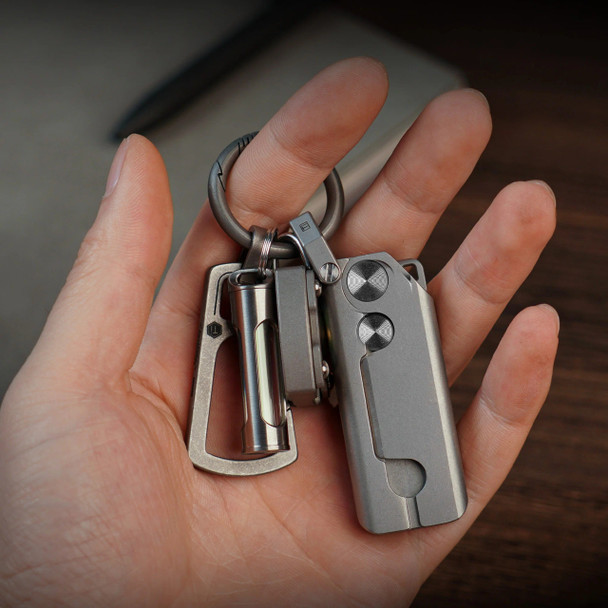
Ideal everyday carry (EDC) backpack weight
The ideal everyday carry (EDC) backpack weight is light enough that the bag itself doesn't dominate your total carry before you've added anything inside it. Lightweight commuter bags can weigh well under 1kg. Heavier tactical or rugged construction bags can reach 1.5kg to 2kg or more before a single item has been added, which pushes your base weight up before the audit has even started. If you can feel the bag structure on your back before you've put anything in it, it's working against your target before the day has started.
Urban everyday carry in the UK: bag categories worth knowing
Urban everyday carry in the UK has its own logic. You're typically mixing a commute, an office environment and incidental outdoor movement in a single daily context. A bag that works on a train, in a meeting room and on wet pavement is a different design brief than a trail pack or a tactical range bag. Many of the strongest urban EDC bags draw design cues from tactical construction: modular organisation, durable fabrics and external attachment points, all wrapped in low-profile aesthetics. That combination works well for UK daily carry without drawing attention in contexts where that matters.
How much is too much to carry?
You have your numbers. Now comes the verdict. How heavy is too heavy for EDC? The answer goes beyond a single figure on a scale. It depends on total load, what you're carrying, how the bag fits and how long you're carrying it each day. Once you've worked through the measurement and target-setting steps above, you're ready to act on what the numbers are telling you.
The Remove, Replace, Upgrade and Keep framework
Every item in your inventory gets one of four verdicts. Work through the list methodically, assigning each item before moving on. Resist the urge to default to Keep for items you haven't genuinely evaluated.
| Verdict | When to use it | What it means for your kit |
|---|---|---|
| Keep | The item earns its place; you use it regularly and know exactly why it's there | No action needed. Log it as verified and move on. |
| Remove | The item has no clear daily use case, or duplicates something else you carry | Take it out. If you miss it, you can add it back. Most people don't. |
| Replace | The item does a real job but at more weight than the job requires | Find a lighter version that performs the same function. The weight saving becomes permanent. |
| Upgrade | The item earns its place but the version you carry isn't performing well enough | Carry something chosen deliberately rather than defaulted to. |
The Replace verdict is where the most consistent everyday carry weight savings come from. A lighter torch that performs just as well. A compact multitool covering the tools you actually use rather than every conceivable tool use. A pocket notebook at a fraction of the weight of a full A5. Each swap reduces your base weight permanently.
The Upgrade verdict works differently and it's worth understanding why. Upgrading means carrying something that does the same job with greater reliability and less daily friction: a multitool you trust under load, a torch with a switch you're confident in, a wallet that hasn't become a filing system for receipts and cards you haven't used in months.
Daily carry essentials vs optional gear
Every item in your kit is either a daily carry essential or optional gear. Essentials are the things that genuinely impair your day without them. Optional gear is everything else. Run your inventory through that filter before applying the four verdict framework above. Optional gear is almost always the fastest source of weight savings without any reduction in useful function. Daily carry essentials earn their weight or they get replaced with something lighter that does the same job.
Smart weight distribution for daily carry
Smart weight distribution for daily carry affects how your kit feels as much as the total figure does. Heavy items belong close to your back and high in the main compartment. Lighter items go in front pockets and outer pockets, where they don't shift the centre of gravity. A torch clipped to an external D ring carries no internal weight at all. A carabiner on a shoulder strap attachment point does the same job without consuming bag space. Repositioning items before removing them is worth trying. It occasionally solves a comfort problem without requiring any gear changes at all.
How much is too much to carry in an EDC sling?
Sling bags sit on a single shoulder and transfer load unevenly across the torso. Their comfort ceiling is lower than a backpack with two straps. How much is too much to carry in an EDC sling is generally considered to be around 2kg loaded. EDC carry specialists recommend keeping a sling's total weight below roughly 4 to 5 pounds (approximately 1.8kg to 2.3kg) for comfortable daily carry. Above that range, the load starts to fatigue the carrying shoulder noticeably over the course of a day. If your sling is consistently heavier than that, thin the contents or move to a two-strap option for heavier carry days.
How to reduce your everyday carry weight
You've run the audit and assigned your verdicts. The next step is acting on them. Here's how to do that systematically rather than getting stuck in second-guessing.
How to reduce your commuter backpack weight
Start with the bag itself. A bag that feels heavy before you've packed it is working against you before the day begins. Move next to your heaviest items: a laptop or tablet, water and primary tools. Consider whether a lightweight laptop sleeve inside a lighter general bag covers the same need as a dedicated laptop commuter pack. Carrying water only when your day genuinely calls for it rather than by default removes approximately 500g to over 1kg from your total, depending on bottle volume and material. Replacing a full-sized multitool with a compact model covering the tools you actually deploy removes a meaningful amount of everyday carry weight from your base permanently, not just for today.
How to simplify EDC carry
To simplify EDC carry is to remove decisions you've already made from the daily process. If your multitool covers flathead and cross-head screwdrivers, you don't need a separate driver pouch. If your everyday carry kit includes a quality folding knife, you probably don't need a separate cutter alongside it in the same context. Each item you carry represents a decision you made at some point. The simplification question is whether those decisions still hold for the life you're actually living now, rather than the one you anticipated when each item was added.
Tips to maximise your everyday carry
A handful of adjustments make a consistent difference over time.
- Review your EDC loadout seasonally rather than adding to it continuously.
- Carry for the day you're actually having.
- Favour genuinely multi-functional items over single-purpose additions.
- Consider pocket carry for items that don't need to live in a bag: a compact folding knife, a pocket torch and a key organiser can all move from bag to pocket without disappearing.
- Moving everyday carry items from bag to pockets redistributes weight without losing them and keeps your most used tools accessible when you need them.
Everyday carry ideas borrowed from ultralight hikers
Ultralight hikers have been running base weight audits for years with a level of rigour that most commuters never apply to daily carry. Their habits translate directly to an urban EDC loadout. They replace items rather than adding to them. They challenge every item against a frequency of use test. If it wasn't touched on the last five outings, it needs a strong justification to come on the next one. They count grams rather than dismissing small additions as negligible. Every item you add into your EDC adds weight, and treating small additions as real costs rather than rounding errors changes the way you build a loadout. Apply that discipline to your everyday carry ideas and the kit gets sharper, lighter and more useful in the same process.
Everyday carry ideas for urban carry in the UK
Urban carry has a different set of pressures to outdoor carry. Office-appropriate, low-profile and compatible with public transport. Everyday carry in the UK urban context means gear that functions in a meeting room as well as on a wet pavement. That context shapes which items earn their weight. For most urban commuters, the strongest EDC loadout is built around precision. The right tool for this specific context, sized and weighted accordingly, rather than a loadout built for every context at once.
Getting the kit right
A thorough everyday carry weight audit covers four stages:
Measure everything, including the bag.
Set targets using the 10% guideline and your specific commute profile.
Apply ‘Remove, Replace, Upgrade or Keep’ to every item in your inventory.
Then act on your verdicts without second-guessing what the audit has already told you.
Everyday carry in the UK adds one further consideration worth folding into the audit: knife law. The everyday carry items you can legally carry without good reason are more specific than many people assume, and confusion around folding blades, locking mechanisms and blade length affects a significant number of UK EDC loadouts. If your carry includes a knife, confirm it sits within UK legal parameters as part of the audit process.
Not sure which multitool, torch or folding knife fits your carry without adding unnecessary weight? Our Heinnie Kit Assist service gives you a free 20-minute video call with the team. No scripts. No pressure. Just practical gear advice from people who've thought about these questions for a long time.
Why not check out our other great blogs For Gear Recommendations And Outdoor Survival Tips