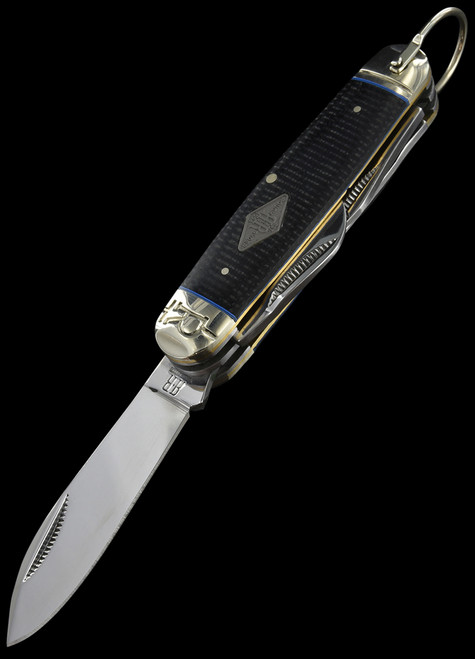
A Whittle of what you fancy …
Some years ago, the British collector Rod Neep had a fascinating website about pocket knife collecting, including a web page about the Seahorse Whittler pattern. As far back as the mid 1600’s, this specific pattern has existed. The distinctively curved “serpentine” frame houses a fairly robust main blade, shaped in what is arguably the most popular and appropriate blade for whittling, the Wharncliffe design. Whittling is a subdivision of wood carving, really; but while wood carving tools include chisels, gouges, skew chisels, scorps, “Sloyd” knives (which are a type of fixed blade knife), etc, and while wood carving is best suited to a studio, workshop, or at least to a permanent or temporary designated area to work in, most people would associate whittling with a handheld piece of suitable wood and a small knife, often a pocket knife, as an item or ornament is gradually made by hand. Chip carving is a related activity, but with other specific tools and methods. Whittling involves creativity and imagination, with useful skills learned along the way. A pocket knife that is UK friendly allows the hobby to be portable and somewhat spontaneous. Unlike other Whittler pattern slip joint pocket knives, that is, folding traditional pocket knives, which more often feature a clip blade or sometimes a spear point blade, the Wharncliffe blade has a very fine tip; so the main blade excels at stock removal and rough shaping, as the main blade on a Whittler should do, whilst also permitting meticulous detail work. Normally the smaller blades, or blade, if only one secondary blade is present, of a Whittler are reserved for more delicate and precise cuts. Rough Ryder has chosen to give half stops to all three blades of this model. The walk and talk is well done, and the blades snap authoritatively into place at the half stops and in the fully opened and closed positions. The weight of this model is a bit hefty, yet the handle contours are smooth and inviting, and the balance whilst using the main blade is quite nice. The smaller blades are both of the Pen pattern, another useful and common choice for smaller secondary blades on many different pocket knife patterns. Case uses a combination of Pen and Coping blade shapes on their Seahorse Whittler, as well as the Wharncliffe main blade, but with a very thick spine on the main blade, without any swedge, which offers a more comfortable support for one’s thumb for push cuts, even when using a “thumb on thumb” technique when control, power, and precision are all important. The Case Seahorse Whittler has no half stops, and it works just fine. As other reviews have noted, it would have been better if Rough Ryder had likewise designed their Wharncliffe main blade with a wider back surface. As it is, all three blades on the Rough Ryder Seahorse Whittler have stylish swedges, or bevels, at the back of the blades, which do not exactly create a sharp edge on the spine of the blades, but are not quite as comfortable for extended sessions of whittling as is the broader Case offering. Swedges do contribute to flexibility of the blades, which is a desirable feature. With regard to this hobby, the well - respected author E. J. Tangerman, in his book “Whittling and Woodcarving,” published in 1936, speaks highly of the importance of a flexible blade for detailed shaping, and of course stresses the need for initial sharpening, and then frequent stropping as the project takes shape. Really, sharpening should only be done to achieve a fine edge, followed by stropping to remove any burrs or “wire edge” remnants from the sharpening process. Stropping is really a must; otherwise, the edge is not truly sharp enough for effective wood carving, which will quickly discourage a beginner. Stropping every few minutes to rapidly restore a very keen edge soon becomes second nature. It only takes a dozen or so alternating strokes, similar to a barber maintaining a razor. The result will be an easy gliding cut going with the grain of the wood, which leaves a glossy finish, even when cutting across the grain. Of course, the harder the wood, the more often the edge should be stropped. But the results are well worth it. Rough Ryder’s Seahorse Whittler is of the split back design, with a central spacer that tapers to nothing. Case’s equivalent, by comparison, also has two full length back springs but with no central spacer visible at the back. Blade rub is quite common in pocket knives when the closed blades overlap; many patterns from many manufacturers exhibit this tendency. So it is not worth fretting over, and most users accept this as part of the charm of taking up the enjoyable hobby of whittling. Patience and perseverance are needed for the beginner; however, mindful attentiveness in short order becomes a sort of therapy, and calm careful techniques will yield a pleasant and satisfying experience. Rough Ryder has done well, overall, with this model. Yes, there are daylight gaps when viewing the back of the pocket knife. And it did need sharpening and stropping to suitably prepare the blades. The badge recess could have been machined more carefully. Yet the total effect is pleasing, and this makes a welcome addition to the modest collection. And it does work! Rough Ryder’s stainless pocket knives have been well received by wood carving enthusiasts for some years now, and their carbon steel models are reportedly also very capable. A small trivia point: my older examples from this manufacturer are clearly stamped “Rough Rider” on the main blade’s tang. The spelling changed somewhere along the way. Cheers to HH for supplying this model, and for a remarkably quick delivery.