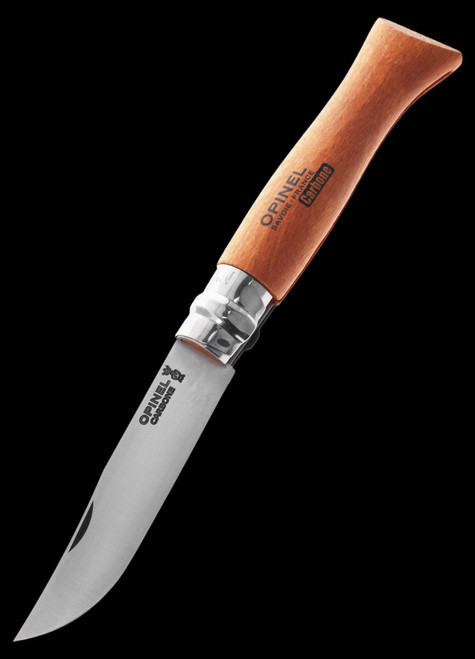
No 6. Excellent pocket knife.
Opinel pocket knives are globally popular. If what you want is a lightweight dependable single blade pocket tool, these work very well. Yes, the handle may absorb moisture and swell up, but keep using it and with time the action will smooth out. Stropping is an easy and effective way to keep it sharp. Cardboard works well, especially when loaded with buffing compound. Paper, especially rough paper, can be used for a strop, too. Honing is also effective, using almost anything to hand. Another Opinel’s blade, the back or side of a kitchen knife, the stainless handle of an ordinary fork or spoon, as long as the surface is smooth and free of nicks and burrs, and even the top or bottom of an aluminium drink can, or the matte edge of a glass shelf or top of a vehicle window; any of these surfaces, and likely many more, can serve as an effective hone. If your posh pocket knife is too nice to use for some jobs, an Opinel is a fine choice. Slipping the locking ring off with external circlip pliers makes the No 6 UK friendly. Don’t just lock it shut and force the blade open with ordinary pliers. The more recently made locking rings have a detent that rides in a groove in the mating inner ring. Forcing the locked blade open used to work well to remove the locking ring but the newer design is resistant to this method to make the knife lockless. The nail, or pivot, will likely deform the surrounding wood, resulting in a blade action that is loose, for at least some of its rotation. So circlip pliers are the best option to remove the locking ring. Discovered this the hard way. Larger sizes can also be made UK friendly, but of course the blade will have to be shortened to no more than three inches, from handle to tip in the open position. The locking ring can always be pressed back on, if desired. Opinels are inexpensive, widely available, very capable, sturdy within sensible limits, and will last for decades with modest care. Very, very heartily recommended. As is HH!