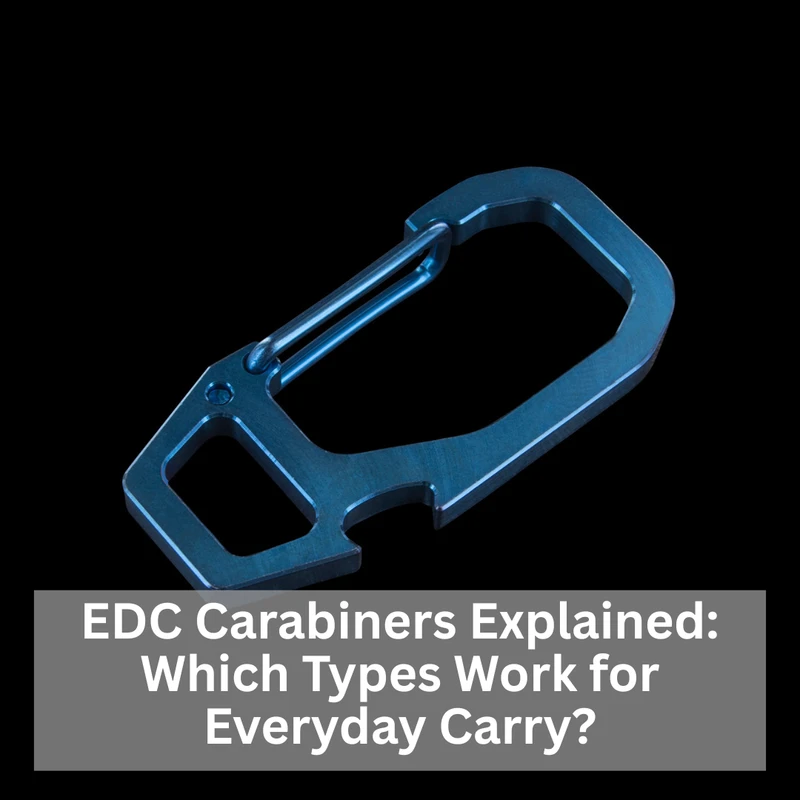
EDC Carabiners Explained: Which Types Work for Everyday Carry?
Posted by Heinnie Haynes on 14th Apr 2026
Carabiners are for anyone who wants their gear organised, accessible and secure. Whether you're clipping keys to a belt loop, attaching a torch to a pack strap or anchoring accessories to a MOLLE rig, the right carabiner keeps your kit exactly where you put it. They earn their place when you need fast, reliable access to things you reach for every day: on the commute, at a workbench or out on the trails. Browse our carabiners and lanyards range and you'll find everything from precision-machined titanium EDC clips to tactical polymer alternatives. This guide explains how carabiners work, what separates one from another and which type suits your carry.
The History of Carabiners
The carabiner has two origin stories, and both are worth knowing.
The word itself traces back to the French carabinier: a type of cavalry soldier from the mid-1600s who carried a shortened rifle known as a carbine. That soldiers' name gave rise to the German Karabinerhaken, meaning ‘carbine hook’, and from there to the English carabiner. The UIAA, the international mountaineering federation, confirms in its own published history that the climbing carabiner descended from a gun hook with a sprung closure that was used to assist in carrying a rifle. The connection between military hardware and a titanium key clip on your belt loop is both linguistic and mechanical.
The climbing chapter took shape around 1910. German mountaineer Otto Herzog, nicknamed ‘Rambo’ from the German word ramponieren meaning ‘to batter’, saw Munich firemen using pear-shaped metal clips on their belts to attach their equipment. He recognised the potential immediately. Snap links that let climbers clip a rope to protection instead of stopping to tie and untie knots would change what was possible on the rock face. He adapted the design for the mountains, and within a few years Hans Dülfer was using carabiners on serious Alpine routes.
Those first versions were steel, heavy and unreliable. The gates could open under load. Climbers routinely used two carabiners in opposing directions to compensate.
The next breakthrough came in the late 1930s. French alpinist Pierre Allain used aluminium alloy from the aerospace industry to produce a carabiner that weighed a fraction of its steel predecessor, commercially available by the late 1940s. Then Italian climbers Riccardo Cassin and Felice Bonaiti developed the D-shaped variant: asymmetrical by design, transferring most of the load onto the spine, which is the strongest section of the frame. In the late 1950s, Yvon Chouinard (later the founder of Patagonia) began forging his own D-shape carabiners and selling them from the back of his car. By 1968 his revised design had smoother corners, a lighter frame and a load capacity that would still meet modern safety standards.
The carabiner was born as a military fastener. It became a climbing tool. Now it lives in pockets, on keyrings and clipped to bag straps. The engineering brief has never changed: attach two things, release them quickly, trust they won't come apart uninvited.
Anatomy of a Carabiner
Every carabiner shares the same basic architecture. Understanding the parts helps you choose the right one for the job.
The spine is the long straight bar opposite the gate. It carries the majority of any load and is the strongest section of the carabiner. In a D-shape or asymmetric D design, the geometry deliberately routes force onto the spine, making the most of available material.
The basket is the curved wide end. In climbing carabiners, this is where the rope sits. In EDC carabiners it's where keys, lanyards or tool attachments are clipped. A wider basket accommodates more gear; a narrower one keeps things compact and lighter.
The gate is the spring-loaded bar that opens and closes. There are three main configurations.
A solid gate is a flat bar with a notched nose. It's strong, simple and common across both climbing and EDC use. The notch at the nose catches the opposite side of the frame to hold the gate shut.
A wire gate replaces the solid bar with a bent wire loop. It's lighter, less prone to freezing in cold conditions and resists gate flutter: the momentary unintentional opening caused by impact vibrations. The Trayvax Titanium and Trayvax Brass carabiners both use wire gates: minimal components, nothing extraneous to fail.
A keylock nose removes the hooking notch entirely. Both the gate tip and the frame nose are flat, mating cleanly without snagging on ropes, slings or gear loops. It's primarily a climbing feature but it appears in EDC designs where snag-free operation is a priority.
The nose is the point on the gate side where the gate closes against the frame. Gate-closed strength at the nose is always lower than spine strength. Cross-loading, where force is applied sideways across the gate and spine rather than along the major axis, reduces strength significantly. It's why dual-gate designs like the Trayvax Black Talon exist: the second gate keeps keys and gear seated in the basket and resists accidental lateral loading during carry.
The locking sleeve is the collar that secures the gate on locking models. On screwgate carabiners it threads manually. On auto-locking versions a spring or ball mechanism closes the gate each time it shuts. Auto-locking designs are standard on carabiners used for belay systems and life safety applications.
Metals and Cross-Section Construction
Material choice shapes performance, weight and how a carabiner ages in daily use.
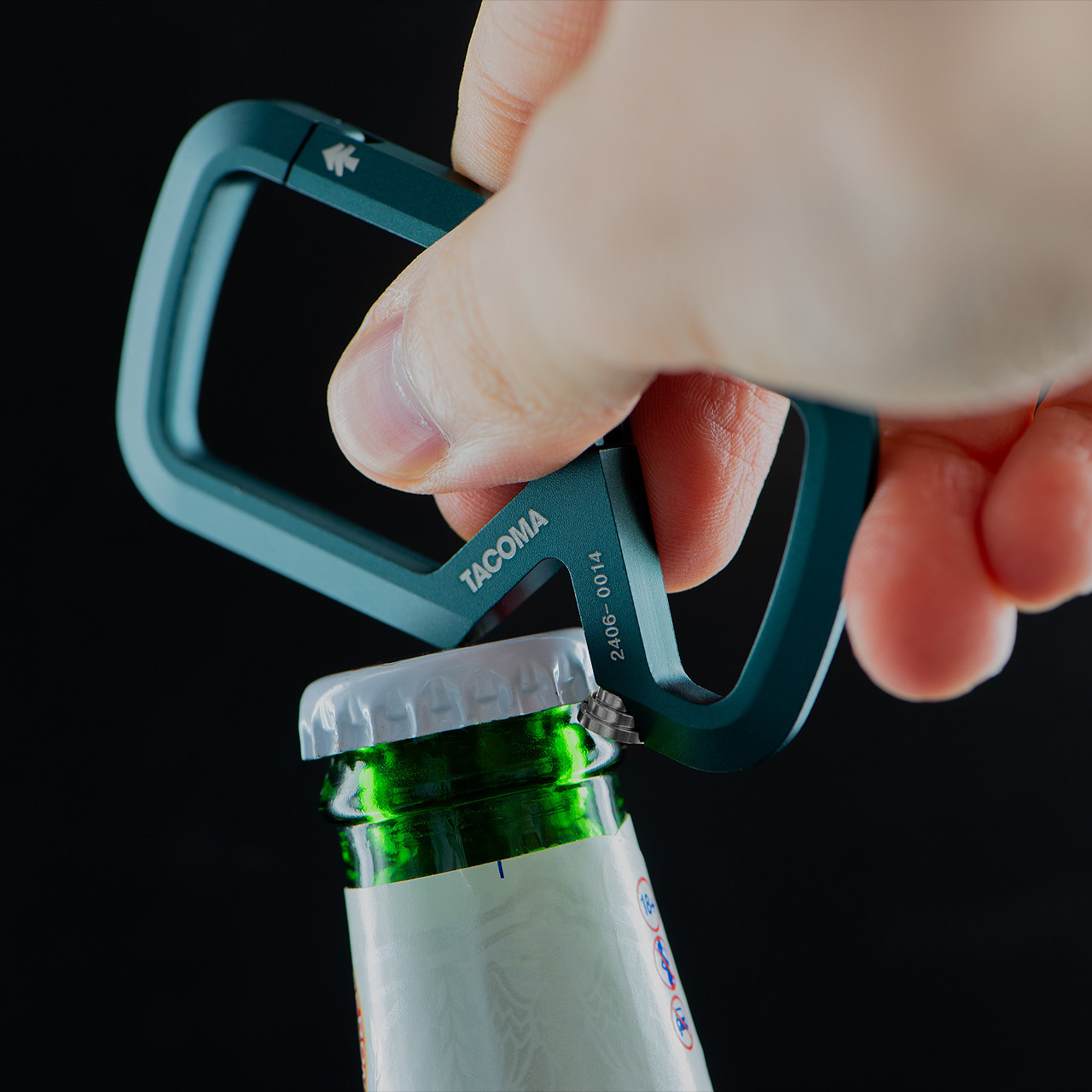
Aluminium is the most common material in climbing hardware and appears across many EDC designs. The James Brand Mehlville uses anodised 6063 aluminium: a grade chosen for its machinability, allowing the dual-compartment construction that locks keys in place when the carabiner is unclipped from a belt. Anodising adds a hardened surface layer that resists scratches and corrosion and allows precise colour in the finish.

Titanium delivers the best strength-to-weight ratio of any common carabiner metal. It resists corrosion without surface treatment and doesn't react with skin oils or sweat. The Trayvax Titanium is CNC-machined from solid billet. The MecArmy CH6 takes a different approach: the spring mechanism is laser-cut directly from the titanium itself, so the material provides the gate's return force. No separate spring component and no separate failure point

Stainless steel is heavier than titanium or aluminium but offers excellent corrosion resistance and high toughness across repeated use. The Trayvax Black Talon uses 420-grade stainless with a black coating: a steel grade selected for toughness in tool applications, with a hardness of 52 HRC that prioritises toughness and corrosion resistance over maximum edge hardness.

Brass is the outlier. Denser than every other option, it develops a patina over time that records use and handling. The Trayvax Brass carabiner is machined from the same billet stock used for Trayvax's Contour wallet frames. It's a considered carry choice for anyone who values how materials change and age with wear.

Polymer is the tactical option. The ITW GrimLoc is moulded from high-strength polymer: corrosion-proof, lightweight and purpose-built for attaching accessories to MOLLE and PALS webbing. It won't rust, won't conduct electricity and won't mark surfaces. In field conditions where corrosion or weight are concerns, it does the job metal can't.

Cross-section matters too. Climbing carabiners typically use an I-beam cross-section: material concentrated at the outer edges of the bar where it provides the greatest bending resistance, with material removed from the centre to save weight. EDC carabiners, particularly multi-tool variants, often use solid bar or milled profiles. Solid construction gives the designer more material to integrate tools into the body; I-beam construction gives the carrier less weight for pure clipping applications.
Standards and Ratings
This section deserves directness: EDC carabiners are not climbing equipment.
Certified climbing carabiners are tested and marked to EN 12275, the European standard for connectors used in mountaineering. Testing applies static loads via tensile testing machines - minimum breaking strengths rather than simulated fall forces. The markings on a climbing carabiner spine state three values:
- major axis strength with the gate closed (minimum 20 kN for a Type B connector)
- gate-open strength (minimum 7 kN)
- minor axis strength (minimum 7 kN)
One kilonewton equals approximately 102 kg of force.
EN 12275 also assigns type codes.
Type B (basic) is the standard all-purpose connector.
Type H (HMS, from the German Halbmastwurfsicherung) is the pear-shaped carabiner used for belay and abseil.
Type K (klettersteig) is the reinforced connector for via ferrata. Type X (oval) is used in pulley and mechanical systems.
These type codes are stamped on the carabiner alongside the strength values - if no type letter is present, it's a Type B.
EDC carabiners carry none of these ratings. They are not PPE. The MecArmy CH6 has a breaking strain of 50kg: it's a precision-engineered titanium key organiser and an excellent one. It is not rated for any life safety application.
If you need a carabiner for working at height, you need a CE-marked, EN 12275-rated connector from a climbing equipment supplier.
If you need one to carry your keys, organise your bag and survive daily use in good condition, that's what our EDC range is built for.
The gap between climbing and EDC ratings isn't a weakness of EDC designs. It reflects completely different engineering briefs. A 50 kg-rated titanium clip machined for daily carry is no more comparable to a 20 kN climbing carabiner than a pocket knife is to a rock drill. Different tools, different jobs, designed for different forces.
Where Carabiners Are Used Indoors
The most common application is the simplest: key organisation.
A carabiner on a belt loop or bag strap keeps keys accessible without burying them in a pocket. The dual-compartment design of the James Brand Mehlville is engineered specifically for this: the second compartment locks keys in place so they don't scatter when you unclip the carabiner from your belt. The TiTech Titanium T61 is a lighter and simpler option in blue-anodised titanium for anyone carrying fewer keys who wants minimum bulk and no unnecessary weight.

Where Carabiners Are Used Outdoors
On the trails, the same principles apply but the environment raises the stakes on reliability.
The Trayvax Titanium and Trayvax Brass carabiners are built for outdoor carry: wire gates, CNC-machined construction and a long attachment slot that works with belt loops, pack straps and gear loops equally well. Titanium is the lighter option; brass is the heavier but develops character with use. Both are corrosion-resistant. Both are designed to stay functional after exposure to rain, mud and daily handling.
For pack attachment, a carabiner on a shoulder strap or hipbelt loop gives you fast access to water bottles, gloves or a map pouch without breaking stride. The TiTech T61 earns its place on a long hike for exactly this: lightweight, strong and the bottle-opening function is a practical bonus at the end of a day on the hills.
For motorcyclists and cyclists, carabiners on a tail bag or tank bag strap keep essentials accessible without needing to pull over and dig into a pannier. Multi-tools and small pouches clipped to the exterior of a bag are ready without dismounting.
For tactical and duty applications, the ITW GrimLoc changes the approach entirely. Standard metal carabiners on MOLLE webbing can rattle, corrode and snag. The GrimLoc sits flush on PALS webbing and releases with one hand. Its high-strength polymer construction is corrosion-proof, and the breakaway design eliminates snagging during movement. It's used to attach pouches and accessories to plate carriers and plate carrier accessories.
In a bushcraft or camping context, carabiners are the connective tissue of camp organisation. Hanging a cook kit from a bear bag line, clipping a head torch to a tent loop, attaching a dump pouch to the outside of a pack: the carabiner manages the connections that keep your kit accessible and your setup tidy without adding meaningful weight to the load.
The distance from Otto Herzog clipping a fire brigade hook to a climbing rope in 1910 to clipping a machined titanium carabiner to a pack strap today is shorter than it looks. The engineering brief hasn't changed.
Keep it secure. Make it fast. Trust it every time.
Disclaimer
The carabiners featured in this guide are EDC accessories intended for organising and carrying everyday gear. They are not rated, tested or certified for climbing, working at height or any life safety application. If you need a connector for use as personal protective equipment, you require a CE-marked product tested to EN 12275 or the relevant standard for your activity. Always consult a qualified professional before selecting equipment for safety-critical use.
Why not check out our other great blogs For Gear Recommendations And Outdoor Survival Tips