Exploring and Clarifying UK Knife Law
Posted by HH on 8th Sep 2015
UK knife legislation can be confusing, particularly around what can and cannot be carried, the following addresses common questions the Heinnie team get. All the information in this post is correct as of posting (March 2026), but laws can and do change so please see the UK Government website for full details (links at the end).
Is this knife legal?
This is the most common question we get asked. It is also often the wrong question. When people ask the question ‘Is my knife legal?’ Generally they are asking about the law as it applies to carrying a knife publically. This is a different question all together. Any item listed on the Heinnie store is legal to own in the UK therefore the question more accurately could be phrased 'Can I carry this knife? (covered below)'. There are a number of banned types which you will not find on the store, these include:
flick knives (also called ‘switchblades’ or ‘automatic knives’) – where the blade is hidden inside the handle and shoots out when a button is pressed
butterfly knives – where the blade is hidden inside a handle that splits in two around it, like wings; the handles swing around the blade to open or close it
disguised knives, eg where the blade is hidden inside a belt buckle or fake mobile phone
gravity knives
sword-sticks
samurai swords (with some exceptions, including antiques and swords made to traditional methods before 1954)
hand or foot-claws
push daggers
See link below for a more detailed list.
(https://www.gov.uk/buying-carrying-knives)
Can I Carry This Knife?
For most people, this is the most important question. If a knife appears on the list of completely prohibited weapons above, you should not own it at all. However, if the knife is not banned, there are still important rules about when and where it can be carried.
A common misunderstanding is that owning a locking knife or a fixed-blade knife is illegal. That is not true. You can legally own these knives. The restriction is that you cannot carry them in a public place without a good reason.
What counts as a “good reason” is partly up to good judgment and down to the discretion of a police officer, but the UK government gives several clear examples:
- Carrying knives you use for work, when travelling to or from your job
- Taking knives to a gallery or museum for exhibition
- Using a knife for theatre, film, television, historical reenactment, or religious purposes (for example, the kirpan carried by some Sikhs)
In practical terms, this means you can legally own and use a locking or fixed-blade knife at home or in an appropriate settings. This might include bushcraft/ camping in the countryside.
However, the way you use the knife also matters. Using any knife in a threatening or dangerous manner is illegal, regardless of why you are carrying it. This more or less applies to any item, if used in a threatening manner.
In simple terms:
You can own locking and fixed-blade knives but do not carry them in public without a clear and valid reason.
Even if the original reason for carrying a knife is valid, using a knife in a threatening way is against the law.
With this in mind, there is an exemption in the law that outlines a set of specifications that would make an item friendly to carry within the UK in public places.
UK Friendly Carry or 'UK Legal’ Knives
A “UK-friendly” knife refers to a specific legal exemption in UK law that allows certain knives to be carried in public without needing the “good reason” referred to above. These knives are often called pocket knives, UK friendly knives, UK legal knives, UK Carry knives or everyday carry knives.
To qualify for this exemption, the knife must meet all three of the following conditions:
- It must be a folding knife
- It must be non-locking
- The cutting edge must be under 7.62 cm (3 inches)
Knives that meet these criteria can generally be carried in public places without needing to justify why you have them.
However, this does not mean you can take them everywhere. Some locations have their own rules or laws that prohibit carrying any kind of knife, regardless of size or type. Examples include:
- Airports
- Government buildings
- Sports stadiums
- Certain events or venues
Because of this, if you plan to carry a knife, even a small legal one, you should check the rules for the place you are going.
A good rule of thumb is to avoid taking a pocket knife into crowded places and plan ahead.
Are you sure this knife is UK Friendly Carry?
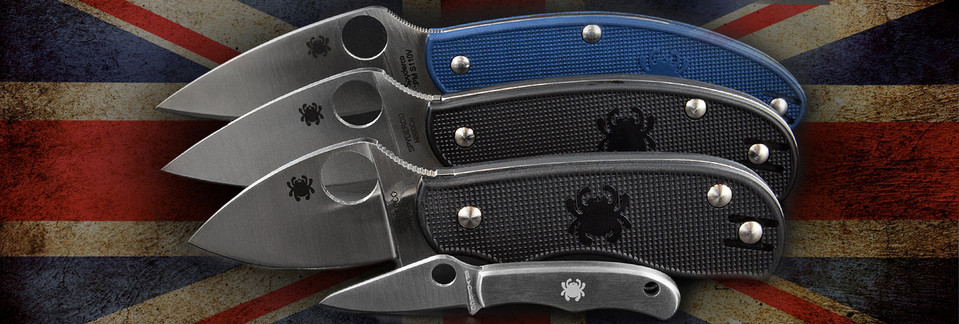
The Heinnie team vets items as they land to ensure they fit the UK friendly carry conditions. It can be confusing with the number of shapes and sizes of knife available on the store, and so we mark each knife in the specifications and at the header of the product page with UK Friendly carry, along with a green tick. Take for example the Boker Plus Tech-Tool 1 and the Spyderco Bug.
Not all retailers of knives and tools mark if items fit the UK friendly carry exemption, so please be careful and make your own judgements when purchasing. Make sure that if you do want a knife you can carry, you don’t just look at size, you also look at whether it locks or not.
In order to stay compliant, use the below Gov.uk guidance:
https://www.gov.uk/buying-carrying-knives
Tags
Why not check out our other great blogs For Gear Recommendations And Outdoor Survival Tips